1. If in triangles ABC and DEF, ABEF.. = ACDE.., then they will be similar when
(a) ∠A = ∠D
(b) ∠A = ∠E
(c) ∠B = ∠E
(d) ∠C = ∠F
2.A square and a rhombus are always
(a) similar
(b) congruent
(c) similar but not congruent
(d) neither similar nor congruent
3. If ΔABC ~ ΔDEF and EF = 13.. BC, then ar(ΔABC):(ΔDEF) is
(a) 3 : 1.
(b) 1 : 3.
(c) 1 : 9.
(d) 9 : 1.
4. If a triangle and a parallelogram are on the same base and between same parallels, then what is the ratio of the area of the triangle to the area of parallelogram?
(a) 1 : 2
(b) 3 : 2
(c) 1 : 3
(d) 4 : 1
5. D and E are respectively the points on the sides AB and AC of a triangle ABC such that AD = 2 cm, BD = 3 cm, BC = 7.5 cm and DE || BC. Then, length of DE (in cm) is
(a) 2.5
(b) 3
(c) 5
(d) 6
6. Which geometric figures are always similar?
(a) Circles
(b) Circles and all regular polygons
(c) Circles and triangles
(d) Regular
7. ΔABC ~ ΔPQR, ∠B = 50° and ∠C = 70° then ∠P is equal to
(a) 50°
(b) 60°
(c) 40°
(d) 70°
8. In triangle DEF,GH is a line parallel to EF cutting DE in G and and DF in H. If DE = 16.5, DH = 5, HF = 6 then GE = ?
(a) 9
(b) 10
(c) 7.5
(d) 8
9. In a rectangle Length = 8 cm, Breadth = 6 cm. Then its diagonal = …
(a) 9 cm
(b) 14 cm
(c) 10 cm
(d) 12 cm
10. In triangle ABC ,DE || BC AD = 3 cm, DB = 8 cm AC = 22 cm. At what distance from A does the line DE cut AC?
(a) 6
(b) 4
(c) 10
(d) 5
Very Short Questions:
1.Two sides and the perimeter of one triangle are respectively three times the corresponding sides and the perimeter of the other triangle. Are the two triangles similar? Why?
2.A and B are respectively the points on the sides PQ and PR of a ∆PQR such that PQ = 12.5 cm, PA = 5 cm, BR = 6 cm, and PB = 4 cm. Is AB || QR? Give reason.
3.If ∆ABC ~ ∆QRP, ar(ΔABC)ar(ΔPQR).. = 94.., AB = 18 cm and BC = 15 cm, then find the length of PR.
4.If it is given that ∆ABC ~ ∆PQR with BCQR..=13.., then find ar(ΔPQR)ar(ΔABC)..
5.∆DEF ~ ∆ABC, if DE : AB = 2 : 3 and ar(∆DEF) is equal to 44 square units. Find the area (∆ABC).
6.Is the triangle with sides 12 cm, 16 cm and 18 cm a right triangle? Give reason.
7.In triangles PQR and TSM, ∠P = 55°, ∠Q = 25°, ∠M = 100°, and ∠S = 25°. Is ∆QPR ~ ∆TSM? Why?
8.If ABC and DEF are similar triangles such that ∠A = 47° and ∠E = 63°, then the measures of ∠C = 70°. Is it true? Give reason.
9.Let ∆ABC ~ ∆DEF and their areas be respectively 64 cm2 and 121 cm2. If EF = 15.4 cm, find BC.
10.ABC is an isosceles triangle right-angled at C. Prove that AB2 = 2AC2.
Short Questions :
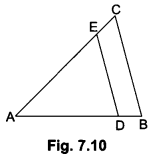
1.In Fig. 7.10, DE || BC. If AD = x, DB = x – 2, AE = x + 2 and EC = x – 1, find the value of x.
2.E and F are points on the sides PQ and PR respectively of a ∆PQR. Show that EF ||QR if PQ = 1.28 cm, PR= 2.56 cm, PE = 0.18 cm and PF = 0.36 cm.
3.A vertical pole of length 6 m casts a shadow 4 m long on the ground and at the same time a tower casts a shadow 28 m long. Find the height of the tower.
4.In Fig. 7.13, if LM || CB and LN || CD, prove that AMAB..=ANAD..
5.In Fig. 7.14, DE || OQ and DF || OR Show that EF || QR.
6.Using converse of Basic Proportionality Theorem, prove that the line joining the mid-points of any two sides of a triangle is parallel to the third side.
7.State which pairs of triangles in the following figures are similar. Write the similarity criterion used by you for answering the question and also write the pairs of similar triangles in the symbolic form.
8.In Fig. 7.17, AOOC.. = BOOD.. = 12.. and AB = 5cm. Find the value of DC.
9.E is a point on the side AD produced of a parallelogram ABCD and BE intersects CD at F. Show that ∆ABE ~ ∆CFB.
10.S and T are points on sides PR and QR of ∆PQR such that ∠P = ∠RTS. Show that ∆RPQ ~ ∆RTS.
Long Questions :
1.Using Basic Proportionality Theorem, prove that a line drawn through the mid-point of one side of a triangle parallel to another side bisects the third side.
2.ABCD is a trapezium in which AB || DC and its diagonals intersect each other at the point O. Show that AOBO.. = CODO...
3.If AD and PM are medians of triangles ABC and PQR respectively, where ∆ABC ~ ∆PQR, prove that ABPQ..=ADPM..
4.In Fig. 7.37, ABCD is a trapezium with AB || DC. If ∆AED is similar to ΔBEC, prove that AD = BC.
5.Prove that the area of an equilateral triangle described on a side of a right-angled isosceles triangle is half the area of the equilateral triangle described on its hypotenuse.
6.If the areas of two similar triangles are equal, prove that they are congruent.
7.Prove that the ratio of the areas of two similar triangles is equal to the square of the ratio of their corresponding medians.
8.In Fig. 7.41,0 is a point in the interior of a triangle ABC, OD ⊥ BC, OE ⊥ AC and OF ⊥ AB. Show that
9.The perpendicular from A on side BC of a ∆ABC intersects BC at D such that DB = 3CD (see Fig. 7.42). Prove that 2AB2 = 2AC2 + BC2
10.In an equilateral triangle, prove that three times the square of one side is equal to four times the square of one of its altitudes.
Case Study Questions:
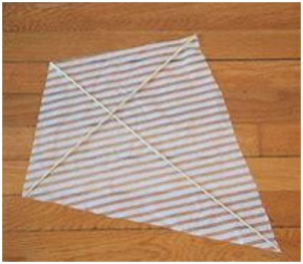
1.Rahul is studying in X Standard. He is making a kite to fly it on a Sunday. Few questions came to his mind while making the kite. Give answers to his questions by looking at the figure.
i.Rahul tied the sticks at what angles to each other?
a.30º
b.60º
c.90º
d.60º
ii.Which is the correct similarity criteria applicable for smaller triangles at the upper part of this kite?
a.RHS
b.SAS
c.SSA
d.AAS
iii.Sides of two similar triangles are in the ratio 4:9. Corresponding medians of these triangles are in the ratio:
a.2 : 3
b.4 : 9
c.81 : 16
d.16 : 81
iv.In a triangle, if the square of one side is equal to the sum of the squares of the other two sides, then the angle opposite the first side is a right angle. This theorem is called.
a.Pythagoras theorem
b.Thales theorem
c.The converse of Thales theorem
d.The converse of Pythagoras theorem
v.What is the area of the kite, formed by two perpendicular sticks of length 6cm and 8cm?
a.48 cm2
b.14 cm2
c.24 cm2
d.96 cm2
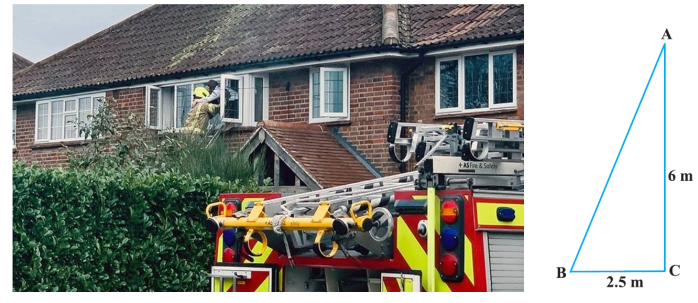
2.There is some fire incident in the house. The fireman is trying to enter the house from the window as the main door is locked. The window is 6m above the ground. He places a ladder against the wall such that its foot is at a distance of 2.5m from the wall and its top reaches the window.
i.Here, ________ be the ladder and ________ be the wall with the window.
a.CA, AB
b.AB, AC
c.AC, BC
d.AB, BC
ii.We will apply Pythagoras Theorem to find length of the ladder. It is:
a.AB2 = BC2 – CA2
b.CA2 = BC2 + AB2
c.BC2 = AB2 + CA2
d.AB2 = BC2 + CA2
iii.The length of the ladder is ________.
a.4.5m
b.2.5m
c.6.5m
d.5.5m
iv.What would be the length of the ladder if it is placed 6m away from the wall and the window is 8m above the ground?
a.12m
b.10m
c.14m
d.8m
v.How far should the ladder be placed if the fireman gets a 9m long ladder?
a.6.7m (approx.)
b.7.7m (approx.)
c.5.7m (approx.)
d.4.7m (approx.)
Assertion Reason Questions-
1.Directions: In the following questions, a statement of assertion (A) is followed by a statement of reason (R). Mark the correct choice as:
a.Both assertion (A) and reason (R) are true and reason (R) is the correct explanation of assertion (A).
b.Both assertion (A) and reason (R) are true but reason (R) is not the correct explanation of assertion (A).
c.Assertion (A) is true but reason (R) is false.
d.Assertion (A) is false but reason (R) is true.
Assertion: If two sides of a right angle are 7 cm and 8 cm, then its third side will be 9 cm.
Reason: In a right triangle, the square of the hypotenuse is equal to the sum of the squares of the other two sides.
2.Directions: In the following questions, A statement of Assertion (A) is followed by a statement of Reason (R). Mark the correct choice as.
a.Both assertion (A) and reason (R) are true and reason (R) is the correct explanation of assertion (A).
b.Both assertion (A) and reason (R) are true but reason (R) is not the correct explanation of assertion (A).
c.Assertion (A) is true but reason (R) is false.
d.Assertion (A) is false but reason (R) is true.
Assertion: If ∆ABC and ∆PQR are congruent triangles, then they are also similar triangles.
Reason: All congruent triangles are similar but the similar triangles need not be congruent.