1.Linear programming is the process of taking various linear inequalities relating to some situation and finding the best value obtainable under those conditions.
2.Linear programming is part of a very important branch of mathematics called ‘Optimization Techniques’.
3.Problems which seek to maximise (or minimise) profit (or cost) form a general class of problems called optimisation problems.
4.A problem which seeks to maximise or minimise a linear function, subject to certain constraints as determined by a set of linear inequalities, is called an optimisation problem.
5.A linear programming problem may be defined as the problem of maximising or minimising a linear function subject to linear constraints. The constraints may be equalities or inequalities.
6.Objective function: The linear function Z = ax + by, where a and b are constants and x and y are decision variables, which has to be maximised or minimised is called a linear objective function. An objective function represents cost, profit or some other quantity to be maximised or minimised subject to constraints.
7.Linear inequalities or equations which are derived from the application problem are problem constraints.
8.Linear inequalities or equations or restrictions on the variables of a linear programming problem are called constraints.
9.The conditions x≥0 and y ≥ 0 are called non-negative restrictions. Non-negative constraints are included because x and y are usually the number of items produced and one cannot produce a negative number of items. The smallest number of items one could produce is zero. These conditions are not (usually) stated; they are implied.
10. A linear programming problem is one which is concerned with finding the optimal value (maximum or minimum value) of a linear function (called objective function) of several variables (say x and y) subject to the conditions that the variables are non-negative and satisfy a set of linear inequalities (called linear constraints).
11. In linear programming, the term linear implies that all the mathematical relations used in the problem are linear while programming refers to the method of determining a particular program me or plan of action.
12. Forming a set of linear inequalities (constraints) for a given situation is called formulation of the linear programming problem (LPP).
13. Mathematical formulation of linear programming problems
Step I: In every LPP, certain decisions are to be made. These decisions are represented by decision variables. These decision variables are those quantities whose values are to be determined. Identify the variables and denote them as x1, x2, x3 …. or x, y and z etc.
Step II: Identify the objective function and express it as a linear function of the variables introduced in Step I.
Step III: In a LPP, the objective function may be in the form of maximising profits or minimising costs. Hence, identify the type of optimisation, i.e., maximisation or minimisation.
Step IV: Identify the set of constraints stated in terms of decision variables and express them as linear inequations or equations as the case may be.
Step V: Add the non-negativity restrictions on the decision variables, as in the physical problems. Negative values of decision variables have no valid interpretation.
14. General LPP is of the form
Max (or min) Z = c1x1 + c2x2 + . . . + cnxn, where c1,c2, . . . cn are constants and x1, x2, … xn are called decision variables such that Ax≤(≥)B and xi≥ 0.
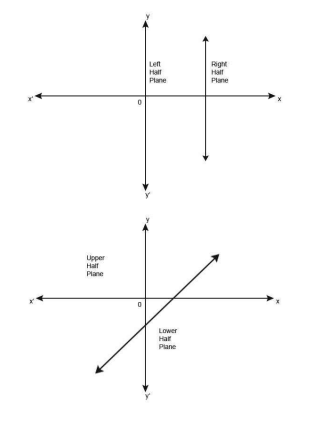
15. A linear inequality in two variables represents a half plane geometrically. There are two types of half planes:
16.A set of values of the decision variables which satisfy the constraints of a linear programming problem is called a solution of LPP.
17. The common region determined by all the constraints including non-negative constraints x, y ≥ 0 of a linear programming problem is called the feasible region (or solution region) for the problem. The region other than the feasible region is called the infeasible region.
18. Points within and on the boundary of the feasible region represent the feasible solution of the constraints.
19. Any point in the feasible region which gives the optimal value (maximum or minimum) of the objective function is called an optimal solution.
20. Any point outside the feasible region is called an infeasible solution.
21. A corner point of a feasible region is the intersection of two boundary lines.
22. A feasible region of a system of linear inequalities is said to be bounded if it can be enclosed within a circle.
23. Corner Point Theorem 1: Let R be the feasible region (convex polygon) for a linear programming problem and let Z = ax + by be the objective function. When Z has an optimal value (maximum or minimum), where the variables x and y are subject to constraints described by linear inequalities, the optimal value must occur at a corner point (vertex) of the feasible region.
24. Corner Point Theorem 2: Let R be the feasible region for a linear programming problem and let Z = ax + by be the objective function. If R is bounded, then the objective function Z has both a maximum and a minimum value on R and each of these occurs at a corner point (vertex) of R.
25. If R is unbounded, then a maximum or a minimum value of the objective function may not exist.
26. The graphical method for solving linear programming problems in two unknowns is as follows:
A.Graph the feasible region.
B.Compute the coordinates of the corner points.
C.Substitute the coordinates of the corner points into the objective function to see which gives the optimal value.
D.When the feasible region is bounded, M and m are the maximum and minimum values of Z.
E.If the feasible region is not bounded, then this method can be misleading. Optimal solutions always exist when the feasible region is bounded but may or may not exist when the feasible region is unbounded.
i.M is the maximum value of Z if the open half plane determined by ax + by > M has no point in common with the feasible region. Otherwise, Z has no maximum value.
ii.Similarly, m is the minimum value of Z if the open half plane determined by ax + by < m has no point in common with the feasible region. Otherwise, Z has no minimum value.
27. Points within and on the boundary of the feasible region represent the feasible solutions of the constraints.
28. If two corner points of the feasible region are both optimal solutions of the same type, i.e., both produce the same maximum or minimum for the function, then any point on the line segment joining these two points is also an optimal solution of the same type.
29. Types of Linear Programming Problems
i.Manufacturing problems: Problems dealing with the determination of the number of units of different products to be produced and sold by a firm, when each product requires fixed manpower, machine hours and labour hour per unit of product, in order to make maximum profit.
ii.Diet problems: Problems dealing with the determination of the amount of different kinds of nutrients which should be included in a diet so as tominimise the cost of the desired diet such that it contains a certain minimum amount of each constituent/nutrient.
iii.Transportation problems: Problems dealing with the determination of the transportation schedule for the cheapest way to transport a product from plants/factories situated at different locations to different markets.
30. Advantages of LPP
i.The linear programming technique helps to make the best possible use of the available productive resources (such as time, labour, machines etc.).
ii.A significant advantage of linear programming is highlighting of such bottle necks.
31. Disadvantages of LPP
i.Linear programming is applicable only to problems where the constraint and objective functions are linear, i.e., where they can be expressed as equations which represent straight lines.
ii.Factors such as uncertainty, weather conditions etc. are not taken into consideration.
Important Questions
.
.
Multiple Choice questions-
1. The point which does not lie in the half plane 2x + 3y -12 < 0 is
(a) (1, 2)
(b) (2, 1)
(c) (2, 3)
(d) (-3, 2).
2. The corner points of the feasible region determined by the following system of linear inequalities:
2x + y ≤ 10, x + 3y ≤ 15, x, y ≥ 0 are (0, 0), (5, 0), (3, 4) and (0, 5).
Let Z = px + qy, where p, q > 0. Conditions on p and q so that the maximum of Z occurs at both (3, 4) and (0, 5) is
(a) p = 3q
(b) p = 2q
(c) p = q
(d) q = 3p.
3. The corner points of the feasible region determined by the system of linear constraints are (0, 10), (5, 5), (15, 15), (0, 20). Let Z = px + qy, where p, q > 0. Condition on p and q so that the maximum of Z occurs at both the points (15, 15) and (0, 20) is
(a) p = q
(b) p = 2q
(c) q = 2p
(d) q = 3p.
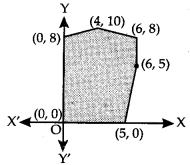
4. The feasible solution for a LPP is shown in the following figure. Let Z = 3x – 4y be the objective function.
Minimum of Z occurs at:
(a) (0, 0)
(b) (0, 8)
(c) (5, 0)
(d) (4, 10).
5. The corner points of the feasible region determined by the system of linear constraints are (0, 10), (5, 5), (15, 15), (0, 20). Let Z = px + qy, where p, q> 0. Condition on p and q so that the maximum of Z occurs at both the points (15, 15) and (0, 20) is Maximum of Z occurs at:
(a) (5, 0)
(b) (6, 5)
(c) (6, 8)
(d) (4, 10).
Very Short Questions:
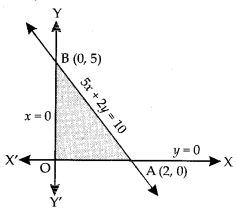
1.Draw the graph of the following LPP:
5x + 2y ≤ 10, x ≥ 0,y ≥ 0.
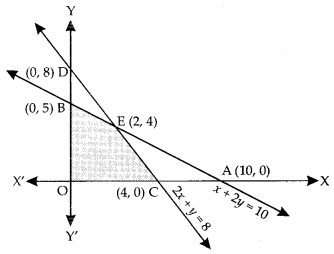
2.Solve the system of linear inequations: x + 2y ≤ 10; 2x + y ≤ 8.
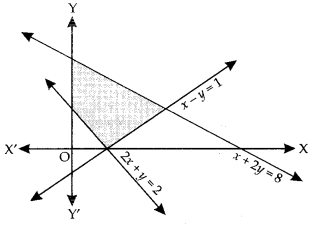
3.Find the linear constraints for which the shaded area in the figure below is the solution set:
4.A small firm manufactures neclaces and bracelets. The total number of neclaces and bracelets that it can handle per day is at most 24. It takes one hour to make a bracelet and half an hour to make a neclace. The maximum number of hours available per day is 16. If the profit on a neclace is ₹100 and that on a bracelet is ₹300. Formulate an LPP for finding how many of each should be produced daily to maximize the profit?
It is being given that at least one of each must be produced. (C.B.S.E. 2017)
5.Old hens can be bought for?2.00 each and young ones at?5.00 each. The old hens lay 3 eggs per week and the young hens lay 5 eggs per week, each egg being worth 30 paise. A hen costs ₹1.00 per week to feed. A man has only ₹80 to spend for hens. Formulate the problem for maximum profit per week, assuming that he cannot house more than 20 hens.
Hence, find the shortest distance between the lines. (C.B.S.E. Sample Paper 2018-19)
2.Minimize and Maximize Z = 5x + 2y subject to the following constraints: x – 2y ≤ 2, 3x + 2y < 12, -3x + 2y ≤ 3, x ≥ 0, y ≥ 0. (A.I.C.B.S.E. 2015)
Assertion and Reason Questions:
1. Two statements are given-one labelled Assertion (A) and the other labelled Reason (R). Select the correct answer to these questions from thecodes(a), (b), (c) and (d) as given below.
a)Both A and R are true and R is the correct explanation of A.
b)Both A and R are true but R is not the correct explanation of A.
c)A is true but R is false.
d)A is false and R is true.
e)Both A and R are false.
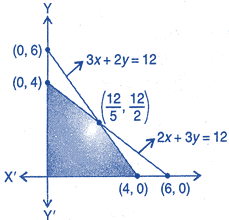
Consider the graph of 2x+3y≤12, 3x+2y≤12, x≥0, y≥0.
Assertion(A):(5, 1) is an infeasible solution of the problem.
Reason (R):Any point inside the feasible region is called an infeasible solution.
2.Two statements are given-one labelled Assertion (A) and the other labelled Reason (R). Select the correct answer to these questions from thecodes(a), (b), (c) and (d) as given below.
a)Both A and R are true and R is the correct explanation of A.
b)Both A and R are true but R is not the correct explanation of A.
c)A is true but R is false.
d)A is false and R is true.
e)Both A and R are false.
Consider the graph of constraints
5x + y ≤ 100, x + y ≤ 60, x, y ≥ 0
Assertion (A):The points (10, 50), (0, 60) and (20, 0) are feasible solutions.
Reason(R):Points within and on the boundary of the feasible region represents infeasible solutions.
Case Study Questions:
1.Suppose a dealer in rural area wishes to purpose a number of sewing machines. He has only ₹ 5760 to invest and has space for at most 20 items for storage. An electronic sewing machine costs him ₹ 360 and a manually operated sewing machine ₹ 240. He can sell an electronic sewing machine at a profit of ₹ 22 and a manually operated sewing machine at a profit of ₹ 18.
Based on the above information, answer the following questions.
(i)Let x and y denotes the number of electronic sewing machines and manually operated sewing machines purchased by the dealer. If it is assume that the dealer purchased atleast one of the the given machines, then:
a.X+y≥0
b.X+y<0
c.X+y>0
d.X+y≤0
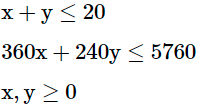
(ii)Let the constraints in the given problem is represented by the following inequalities.
Then which of the following point lie in its feasible region.
a.(0, 24)
b.(8, 12)
c.(20, 2)
d.None of these
(iii)If the objective function of the given problem is maximise z = 22x + 18y, then its optimal value occur at:
a.(0, 0)
b.(16, 0)
c.(8, 12)
d.(0, 20)
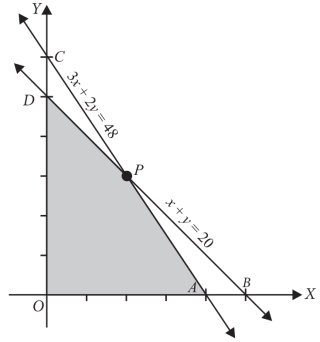
(iv)Suppose the following shaded region APDO, represent the feasible region corresponding to mathematical formulation of given problem.
Then which of the following represent the coordinates of one of its corner points
a.(0, 24)
b.(12, 8)
c.(8, 12)
d.(6, 14)
(v)If an LPP admits optimal solution at two consecutive vertices of a feasible region, then:
a.The required optimal solution is at the midpoint of the tine joining two points.
b.The optimal solution occurs at every point on the tine joining these two points.
c.The LPP under consideration is not solvable.
d.The LPP under consideration must be reconstructed.
2.Corner points of the feasible region for an LPP are (0, 3), (5, 0), (6, 8), (0, 8). Let Z = 4x – 6y be the objective function.
Based on the above information, answer the following questions.
(i)The minimum value of Z occurs at:
a.(6, 8)
b.(5, 0)
c.(0, 3)
d.(0, 8)
(ii)Maximum value of Z occurs at:
a.(5, 0)
b.(0, 8)
c.(0, 3)
d.(6, 8)
(iii)Maximum of Z – Minimum of Z =
a.58
b.68
c.78
d.88
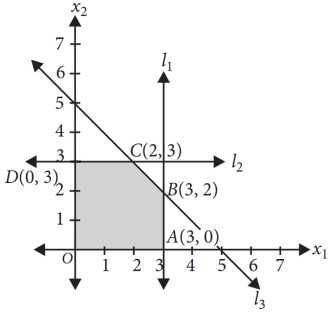
(iv)The corner points of the feasible region determined by the system of linear inequalities are:
a.(0, 0), (-3, 0), (3, 2). (2, 3)
b.(3, 0), (3, 2), (2, 3), (0, -3)
c.(0, 0), (3, 0), (3, 2), (2, 3), (0, 3)
d.None of these
(v)The feasible solution of LPP belongs to:
a.First and second quadrant.
b.First and third quadrant.
c.Only second quadrant.
d.Only first quadrant.
Answer Key-
Multiple Choice questions-
1.Answer: (c) (2, 3)
2.Answer: (d) q = 3p.
3.Answer: (d) q = 3p.
4.Answer: (b) (0, 8)
5.Answer: (a) (5, 0)
Very Short Answer:
1.Solution:
Draw the line AB: 5.v + 2y = 10 …(1),
which meets x-axis at A (2, 0) and y-axis at B (0,5).
Also, x = 0 is y-axis and y = 0 is x-axis.
Hence, the graph of the given LPP is as shown (shaded):
2.Solution:
Draw the st. lines x + 2y = 10 and 2x + y = 8.
These lines meet at E (2,4).
Hence, the solution of the given linear inequations is shown as shaded in the following figure :
3.Solution:
From the above shaded portion, the linear constraints are :
2x + y ≥ 2,x – y ≤ 1,
x + 2y ≤ 8, x ≥ 0, y ≥ 0.
4.Solution:
Let ‘x’ neclaces and ‘y’ bracelets be manufactured per day.
Then LPP problem is:
Maximize Z = 100x+300y
Subject to the constraints : x + y ≤ 24,
(1) (x) + 12..y ≤ l6,
i.e. 2x + y ≤ 32
and x ≥ 1
and y ≥ 1
i.e. x – 1 ≥ 0
and y – 1 ≥ 0.
5.Solution:
Let ‘x’ be the number of old hens and ‘y’ the number of young hens.
Profit = (3x + 5y) 30100.. – (x + y) (1)
= 9x10..+32..yx – y
= y2..−x10..=5y−x10..
∴ LPP problem is:
Maximize Z = 5y−x10.. subject to:
x ≥ 0,
y ≥ 0,
x + y ≤ 20 and
2x + 5y ≤ 80.
Long Answer:
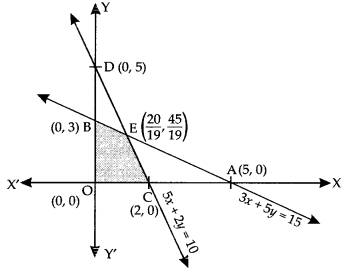
1.Solution:
The system of constraints is :
3x + 5y ≤ 15 …(1)
5x + 2y ≤ 10 …(2)
and x ≥ 0, y≥ 0 …(3)
The shaded region in the following figure is the feasible region determined by the system of constraints (1) – (3):
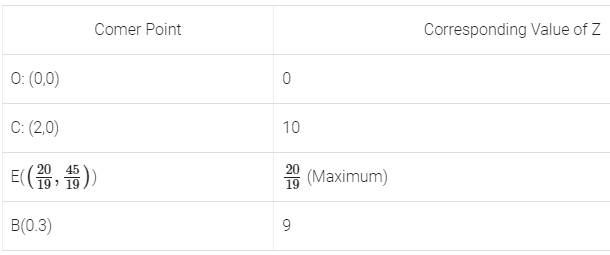
It is observed that the feasible region OCEB is bounded. Thus we use Corner Point Method to determine the maximum value of Z, where:
Z = 5x + 3y …(4)
The co-ordinates of O, C, E and B are (0, 0), (2,0), (2019..,4519..) (Solving 3x + 5y = 15 and 5x + 2y – 10) and (0, 3) respectively.
We evaluate Z at each comer point:
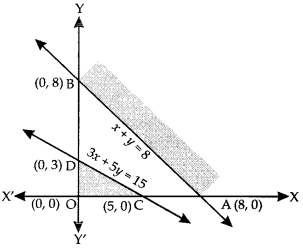
2.Solution:
The system of constraints is :
x +y ≥ 8, , x ≥ 0, y ≥ 0…(1)
3x + 5y ≤ 15 …(2)
and x ≥ 0, y ≥ 0 …(3)
It is observed that there is no point, which satisfies all (1) – (3) simultaneously.
Thus there is no feasible region.
Hence, there is no feasible solution.
Solution:
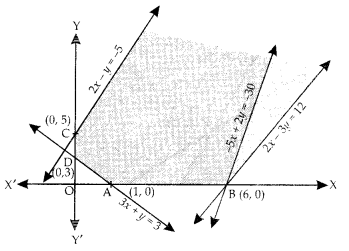
The system of constraints is :
2x-y ≥ – 5 …(1)
3x +y ≥ 3 …(2)
2x – 3y ≤ 12 …(3)
and x,y ≥ 0 …(4)
The shaded region in the following figure is the feasible region determined by the system of constraints (1) – (4).
t is observed that the feasible region is unbounded.
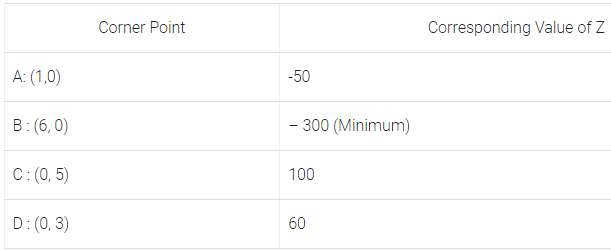
We evaluate Z = – 50x + 20y at the corner points:
A (1, 0), B (6, 0), C (0, 5) and D (0, 3):
From the table, we observe that – 300 is the minimum value of Z.
But the feasible region is unbounded.
∴– 300 may or may not be the minimum value of Z. ”
.
For this, we draw the graph of the inequality.
– 50x + 20y < – 300
i.e. – 5x + 2y < – 30.
Since the remaining half-plane has common points with the feasible region,
∴ Z = – 50x + 20y has no minimum value.
3.Solution:
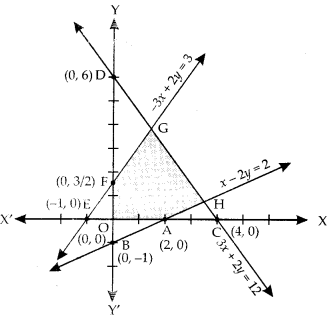
The given system of constraints is:
x – 2y ≤ 2 …(1)
3x + 2y < 12 …(2)
-3x + 2y ≤ 3 …(3)
and x ≥ 0, y ≥ 0.
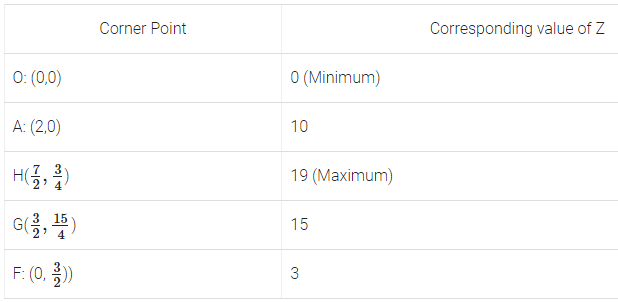
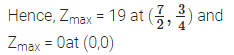
The shaded region in the above figure is the feasible region determined by the system of constraints (1) – (4). It is observed that the feasible region OAHGF is bounded. Thus we use Corner Point Method to determine the maximum and minimum value of Z, where
Z = 5x + 2y …(5)
The co-ordinates of O, A, H, G and F are :
(0, 0). (2. 0), (72..,34..) and (32..,154..,32..)
respectively. [Solving x
2y = 2 and 3x + 2y = 12 for
H and -3x + 2y = 3 and
3x + 2y = 12 for G]
We evaluate Z at each corner point:
Case Study Answers:
1. Answer :
(i)(c) x+y>0
(ii)(b) (8, 12)
Solution:
Since (8, 12) satisfy all the inequalities, therefore (8, 12) is the point in its feasible region.
(iii)(c) (8, 12)
Solution:
At (0, 0), z = 0
At (16, 0), z = 352
At (8, 12), z = 392
At (0, 20), z = 360
It can be observed that max z occur at (8, 12). Thus, z will attain its optimal value at (8, 12).
(iv)(c) (8, 12)
Solution:
We have, x + y = 20 (i)
And 3x + 2y = 48 (ii)
On solving (i) and (ii), we get
x = 8, y = 12.
Thus, the coordinates of Pare (8, 12) and hence (8, 12) is one of its corner points.
(v)(b) The optimal solution occurs at every point on the tine joining these two points.
Solution:
The optimal solution occurs at every point on the line joining these two points.
2. Answer :
Construct the following table of values of objective function:
Corner Points
Value of Z = 4x – 6y
(0, 3)
4 × 0 – 6 × 3 = -18
(5, 0)
4 × 5 – 6 × 0 = 20
(6, 8)
4 × 6 – 6 × 8 = -24
(0, 8)
4 × 0 – 6 × 8 = -48
(i)(d) (0, 8)
Solution:
Minimum value of Z is -48 which occurs at (0, 8).
(ii)(a) (5, 0)
Solution:
Maximum value of Z is 20, which occurs at (5, 0).
(iii)(b) 68
Solution:
Maximum of Z – Minimum of Z = 20 – (-48) = 20 + 48 = 68
(iv)(c) (0, 0), (3, 0), (3, 2), (2, 3), (0, 3)
Solution:
The comer points of the feasible region are O(0, 0), A(3, 0), B(3, 2), C(2, 3), D(0, 3).