1.A function f(x) is said to be continuous at a point c if.
2.A real function f is said to be continuous if it is continuous at every point in the domain of f.
3.If f and g are real-valued functions such that (f o g) is defined at c, then
(f g)(x) – f(g(x)).
If g is continuous at c and if f is continuous at g(c), then (f o g) is continuous at c.
4.A function f is differentiable at a point c if Left Hand Derivative (LHD) = Right Hand Derivative (RHD),
5.If a function f is differentiable at every point in its domain, then
6.If LHD ≠ RHD, then the function f(x) is not differentiable at x = c.
7.Geometrical meaning of differentiability:
The function f(x) is differentiable at a point P if there exists a unique tangent at point P. In other words, f(x) is differentiable at a point P if the curve does not have P as its corner point.
8.A function is said to be differentiable in an interval (a, b) if it is differentiable at every point of (a, b).
9.A function is said to be differentiable in an interval [a, b] if it is differentiable at every point of [a, b].
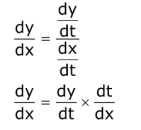
10.Chain Rule of Differentiation: If f is a composite function of two functions u and v such that f = v(t) and
11.Logarithm of a to the base b is x, i.e., logba = x if bx = a, where b > 1 is a real number. Logarithm of a to base b is denoted by logba.
12.Functions of the form x = f(t) and y = g(t) are parametric functions.
13.Rolle’s Theorem: If f : [a, b] → R is continuous on [a, b] and differentiable on (a, b) such that f(a) = f(b), then there exists some c in (a, b) such that f’(c) = 0.
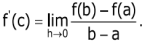
14.Mean Value Theorem: If f : [a, b] → R is continuous on [a, b] and differentiable on (a, b), then thereexists some c in (a, b) such that
Top Concepts
.
1.A function is continuous at x = c if the function is defined at x = c and the value of the function at x = c equals the limit of the function at x = c.
2.If function f is not continuous at c, then f is discontinuous at c and c is called the point of discontinuity of f.
3.Every polynomial function is continuous.
4.The greatest integer function [x] is not continuous at the integral values of x.
5.Every rational function is continuous.
Algebra of continuous functions:
i.Let f and g be two real functions continuous at a real number c, then f + g is continuous at x = c.
ii.f – g is continuous at x = c.
iii.f . g is continuous at x = c.
iv.(fg..) is continuous at x = c, [provided g(c) ≠ 0].
v.kf is continuous at x = c, where k is a constant.
6.Consider the following functions:
i.Constant function
ii.Identity function
iii.Polynomial function
iv.Modulus function
v.Exponential function
vi.Sine and cosine functions
The above functions are continuous everywhere.
7.Consider the following functions:
i.Logarithmic function
ii.Rational function
iii.Tangent, cotangent, secant and cosecant functions
The above functions are continuous in their domains.
8.If f is a continuous function, then |f| and 1f.. are continuous in their domains.
9.Inverse functions sin-1x, cos-1x, tan-1x, cot-1 x, cosec-1 x and sec-1x are continuous functions on their respective domains.
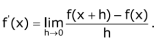
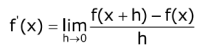
10. The derivative of a function f with respect to x is f’(x) which is given by
11. If a function f is differentiable at a point c, then it is also continuous at that point.
12. Every differentiable function is continuous, but the converse is not true.
13. Every polynomial function is differentiable at each x ∈R .
14. Every constant function is differentiable at each x ∈R .
15. The chain rule is used to differentiate composites of functions.
16. The derivative of an even function is an odd function and that of an odd function is an even function.
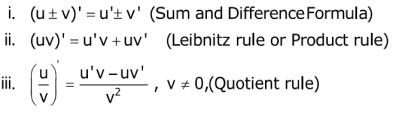
17. Algebra of Derivatives
If u and v are two functions which are differentiable, then
18. Implicit Functions
If it is not possible to separate the variables x and y, then the function f is known as an implicit function.
19. Exponential function: A function of the form y = f(x) = bx, where base b > 1.
1.Domain of the exponential function is R, the set of all real numbers.
2.The point (0, 1) is always on the graph of the exponential function.
3.The exponential function is ever increasing.
20. The exponential function is differentiable at each x ∈R .
21. Properties of logarithmic functions:
i.Domain of log function is R+.
ii.The log function is ever increasing.
iii.For ‘x’ very near to zero, the value of log x can be made lesser than any given real number.
22. Logarithmic differentiation is a powerful technique to differentiate functions of the form f(x) = [u(x)]v(x). Here both f(x) and u(x) need to be positive.
23. To find the derivative of a product of a number of functions or a quotient of a number of functions, take the logarithm of both sides first and then differentiate.
24. Logarithmic Differentiation
y = ax
Taking logarithm on both sides
log y = log ax.
Using the property of logarithms
log y = x log a
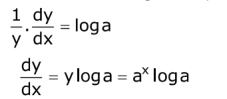
Now differentiating the implicit function
25. The logarithmic function is differentiable at each point in its domain.
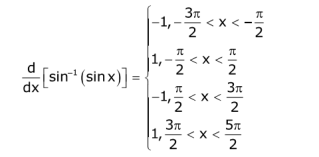
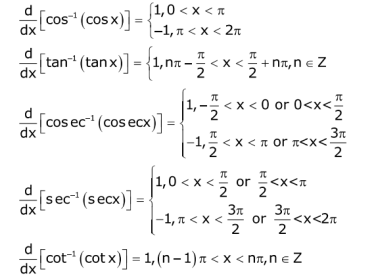
26. Trigonometric and inverse-trigonometric functions are differentiable in their respective domains.
27. The sum, difference, product and quotient of two differentiable functions are differentiable.
28. The composition of a differentiable function is a differentiable function.
29. A relation between variables x and y expressed in the form x = f(t) and y = g(t) is the parametric form with t as the parameter. Parametric equation of parabola y2 = 4ax is x = at2, y = 2at.
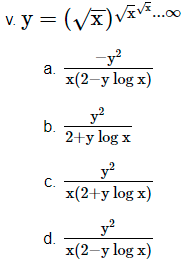
30. Differentiation of an infinite series: If f(x) is a function of an infinite series, then to differentiate the function f(x), use the fact that an infinite series remains unaltered even after the deletion of a term.
31. Parametric Differentiation:
Differentiation of the functions of the form x = f(t) and y = g(t):
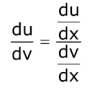
32. Let u = f(x) and v = g(x) be two functions of x. Hence, to find the derivative of f(x) with respect g(x), we use the following formula:
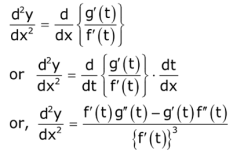
33. If y = f(x) and dydx..=f‘(x) and if f’(x) is differentiable, then
34. If x = f(t) and y = g(t), then
Top Formulae
.
1.Derivative of a function at a point
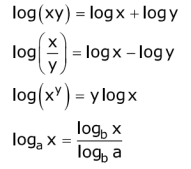
2.Properties of logarithms
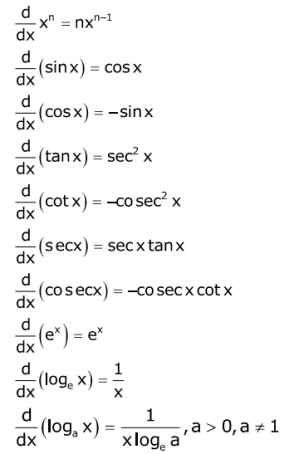
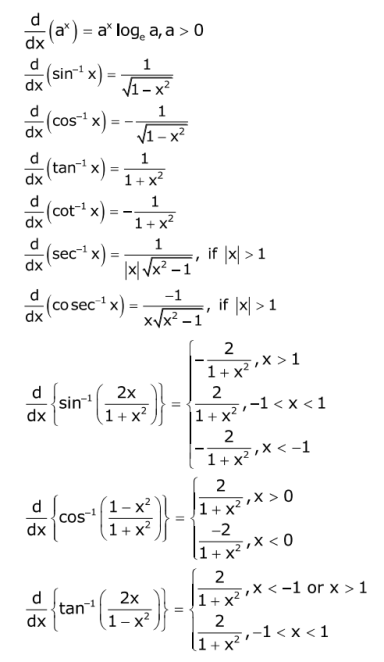
3.Derivatives of Functions
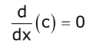
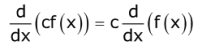
4.Differentiation of constant functions
1.Differentiation of a constant function is zero, i.e.
2.If f(x) is a differentiable function and c is a constant, then cf(x) is a differentiable function such that
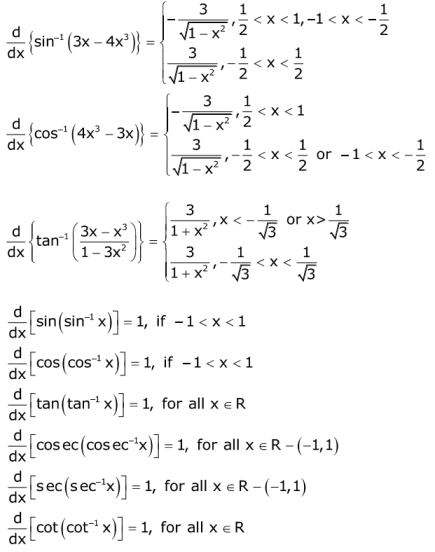
5.Some useful results in finding derivatives
Important Questions
Multiple Choice questions-
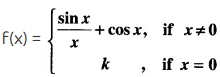
1. The function
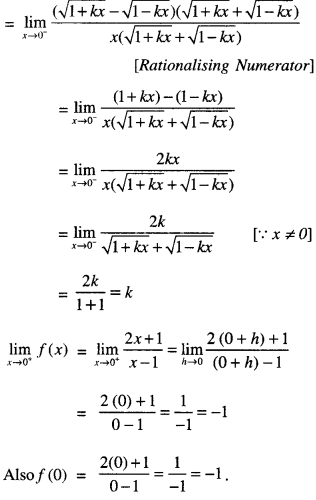
is continuous at x = 0, then the value of ‘k’ is:
(a) 3
(b) 2
(c) 1
(d) 1.5.
2. The function f(x) = [x], where [x] denotes the greatest integer function, is continuous at:
(a) 4
(b)-2
(c) 1
(d) 1.5.
3. The value of ‘k’ which makes the function defined by
continuous at x = 0 is
(a) -8
(b) 1
(c) -1
(d) None of these.
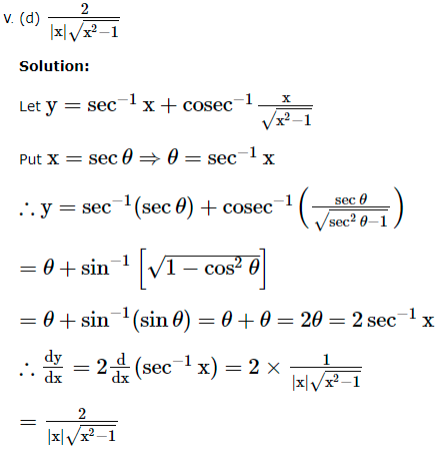
4. Differential coefficient of sec (tan-1 x) w.r.t. x is
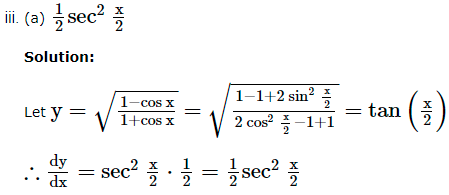
5. If y = log (1−x21+x2..) then dydx.. is equal to:
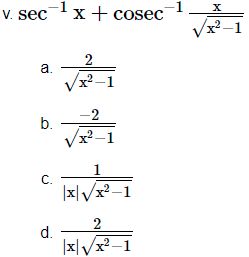
6.
7. If u = sin-1 (2x1+x2..) and u = tan-1 (2x1−x2..) then dydx.. is
(a) 12
(b) x
(c) 1−x21+x2..
(d) 1
8. If x = t², y = t³, then d2ydx2.. is
(a) 32..
(b) 34t..
(c) 32t..
(d) 3t2..
9. The value of ‘c’ in Rolle’s Theorem for the function f(x) = x³ – 3x in the interval [0, √3] is
(a) 1
(b) -1
(c) 32..
(d) 13..
10. The value of ‘c’ in Mean Value Theorem for the function f(x) = x (x – 2), x ∈ [1, 2] is
(a) 32..
(b) 23..
(c) 12..
(d) 34..
Very Short Questions:
1.If y = log (cos ex), then find dydx.. (Delhi 2019)
2.Differentiate cos {sin (x)2} w.r.t. x. (Outside Delhi 2019)
3.Differentiate sin2(x2) w.r.t. x2. (C.B.S.E. Sample Paper 2018-19)
4.Find dydx.., if y + siny = cos or.
5.
6.Is it true that x = elogx for all real x? (N.C.E.R.T.)
7.Differentiate the following w.r.t.x : 3x + 2. (N.C.E.R.T.)
8.Differentiate log (1 + θ) w.r.t. sin-1θ.
9.If y = xx, find dydx...
10.
Short Questions:
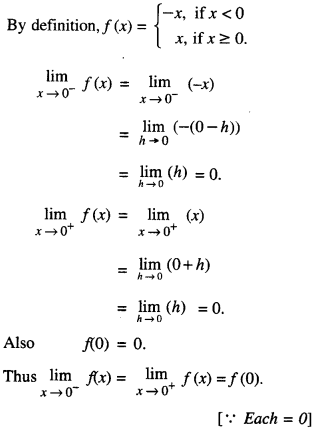
1.Discuss the continuity of the function: f(x) = |x| at x = 0. (N.C.E.R.T.)
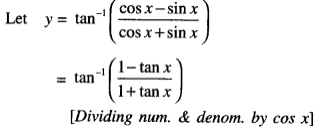
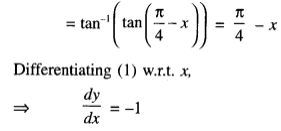
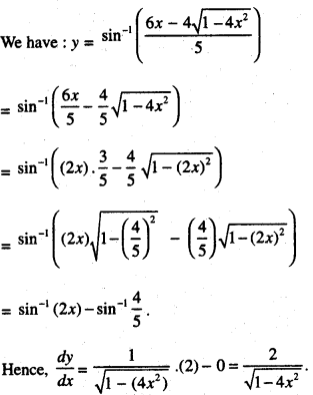
3.Differentiate tan−1 (cosx−sinxcosx+sinx..) with respect to x. (C.B.S.E. 2018 C)
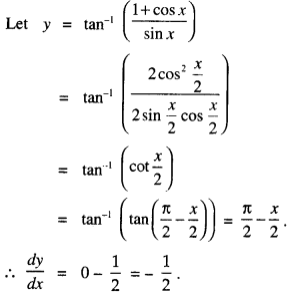
4.Differentiate: tan-1 (1+cosxsinx..) with respect to x. (C.B.S.E. 2018)
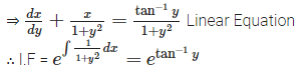
5.Write the integrating factor of the differential equation:
(tan-1 y – x) dy = (1 + y2) dx. (C.B.S.E. 2019 (Outside Delhi))
6.
7.
8.
Long Questions:
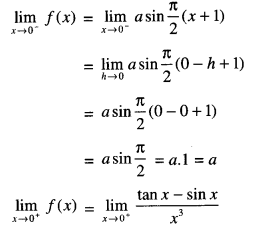
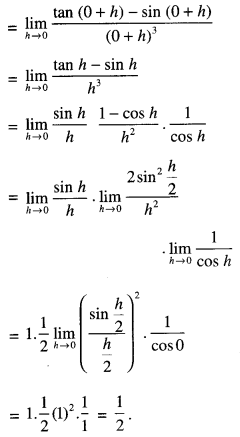
1.Find the value of ‘a’ for which the function ‘f’ defined as:
s continuous at x = 0 (CBSE 2011)
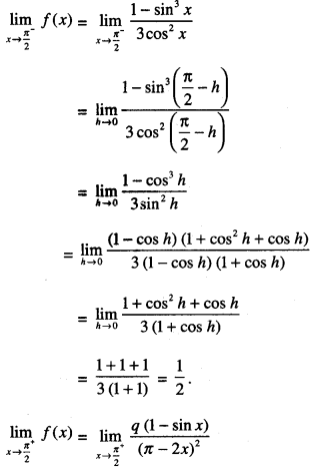
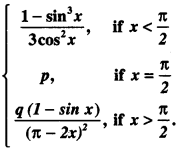
2.Find the values of ‘p’ and ‘q’ for which:
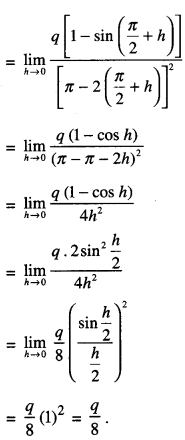
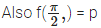
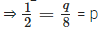
is continuous at x = 2 (CBSE 2016)
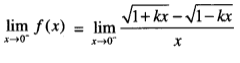
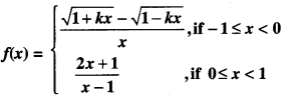
3.Find the value of ‘k’ for which
is continuous at x = 0 (A.I.C.B.S.E. 2013)
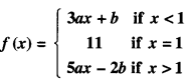
4.For what values of ‘a’ and ‘b\ the function ‘f’ defined as:
is continuous at x = 1. (CBSE 2011)
Assertion and Reason Questions-
1. Two statements are given-one labelled Assertion (A) and the other labelled Reason (R). Select the correct answer to these questions from the codes(a), (b), (c) and (d) as given below.
a)Both A and R are true and R is the correct explanation of A.
b)Both A and R are true but R is not the correct explanation of A.
c)A is true but R is false.
d)A is false and R is true.
e)Both A and R are false.
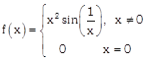
Assertion(A):is continuous at x = 0.
Reason (R):Bothh(x) = x2, are continuous at x = 0.
2. Two statements are given-one labelled Assertion (A) and the other labelled Reason (R). Select the correct answer to these questions from the codes(a), (b), (c) and (d) as given below.
a)Both A and R are true and R is the correct explanation of A.
b)Both A and R are true but R is not the correct explanation of A.
c)A is true but R is false.
d)A is false and R is true.
e)Both A and R are false.
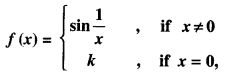
Assertion (A):The function is continuous everywhere.
Reason (R):f(x) is periodic function.
Case Study Questions-
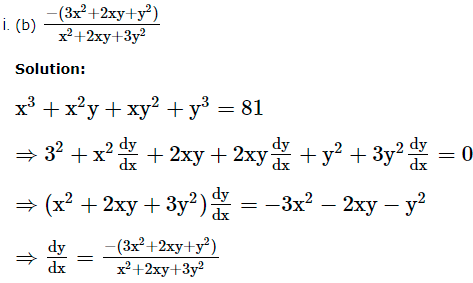
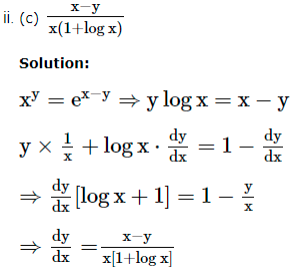
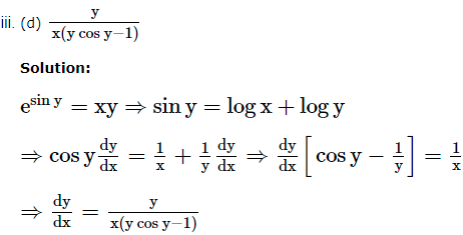
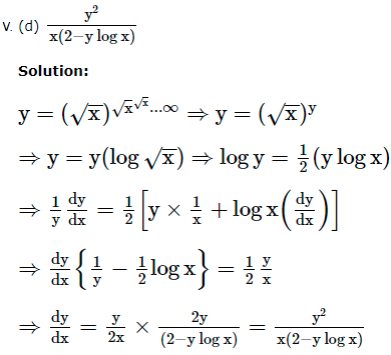
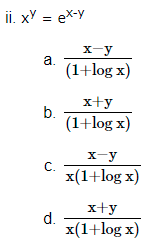
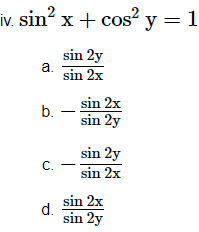
1.If a relation between x and y is such that y cannot be expressed in terms of x, then y is called an implicit function of x. When a given relation expresses y as an implicit function of x and we want to find dydx.., then we differentiate every term of the given relation w.r.t. x, remembering that a tenn in y is first differentiated w.r.t. y and then multiplied by dydx...
Based on the ab:ve information, find the value of dydx.. in each of the following questions.
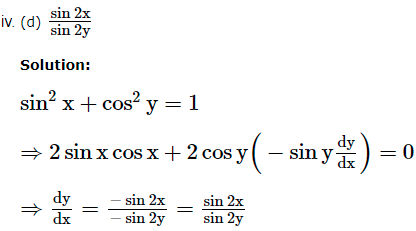
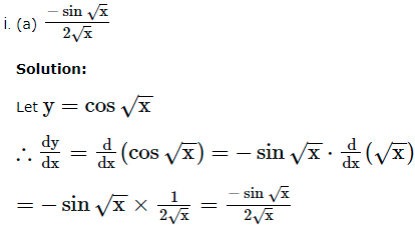
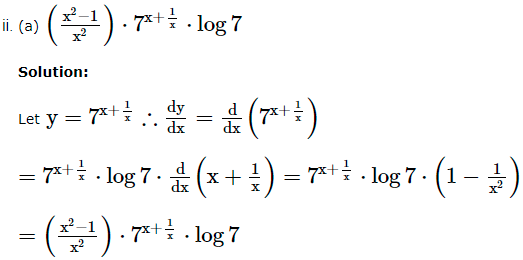
1.If y = f(u) is a differentiable function of u and u = g(x) is a differentiable function of x, then y = f(g(x)] is a differentiable function of x and This rule is also known as CHAIN RULE.
Based on the above information, find the derivative of functions w.r.t. x in the following questions.
Answer Key-
Multiple Choice questions-
1.Answer: (b) 2
2.Answer: (d) 1.5.
3.Answer: (d) None of these.
4.Answer:
5.Answer:
6.Answer:
7.Answer: (d) 1
8.Answer: (b) 34t..
9.Answer: (a) 1
10.Answer: (a) 32..
Very Short Answer:
1.Solution:
We have: y = log (cos ex)
= – ex tan ex
2.Solution:
Let y = cos {sin (x)2}.
∴dydx.. = – sin {sin (x)2}. dydx.. {sin (x)2}
= – sin {sin (x)2}. cos(x)2dydx.. (x2)
= – sin {sin (x)2}. cos(x)22x
= -2x cos(x)2 sin {sin(x)2}.
3.Solution:
Let y = sin2(x2).
∴dydx.. = 2 sin (x2) cos (x2) = sin (2x2).
4.Solution:
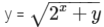
We have: y + sin y = cos x.
Differentiating w.r,t. x, we get:
dydx.. + cos y. dydx.. = – sin x
(1 + cos y)dydx.. = -sin x
Hence, dydx.. = − sin.x1+cos.y..
where y ≠ (2n + 1)π, n ∈ Z.
5.Solution:
Put 3x = sin θ.
y = sin-1 (2 sin θ cos θ)
= sin-1 (sin 2θ) = 2θ
= 2 sin-1 3x
6.Solution:
The given equation is x = elogx
This is not true for non-positive real numbers.
[ ∵ Domain of log function is R+]
Now, let y = elogx
If y > 0, taking logs.,
log y = log (elogx) = log x.log e
= log x . 1 = log x
⇒ y = x.
Hence, x = elogx is true only for positive values of x.






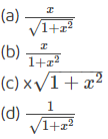
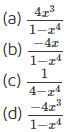
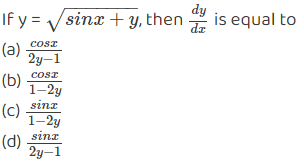


 (tan-1 y – x) dy = (1 + y2) dx. (C.B.S.E. 2019 (Outside Delhi))

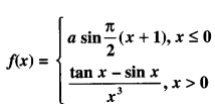
 is continuous at x = 0.
 are continuous at x = 0.
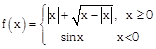 is continuous everywhere.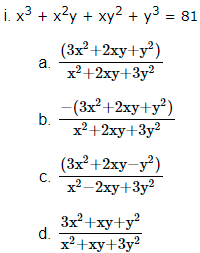

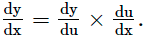 This rule is also known as CHAIN RULE.