●A relation R between two non-empty sets A and B is a subset of their Cartesian product A × B.
●If A = B, then the relation R on A is a subset of A × A.
●The total number of relations from a set consisting of m elements to a set consisting of n elements is 2mn.
●If (a, b) belongs to R, then a is related to b and is written as ‘a R b’. If (a, b) does not belong to R, then a is not related to b and it is written as
2.Co-domain and Range of a Relation
Let R be a relation from A to B. Then the ‘domain of and the ‘range of Co-domain is either set B or any of its superset or subset containing range of R.
3.Types of Relations
A relation R in a set A is called an empty relation if no element of A is related to any element of A, i.e.,
A relation R in a set A is called a universal relation if each element of A is related to every element of A, i.e., R = A × A.
4.A relation R on a set A is called:
a.Reflexive, if (a, a) ∈ R for every a ∈ A.
b.Symmetric, if (a1, a2) ∈ R implies that (a2, a1) ∈ R for all a1, a2∈A.
c.Transitive, if (a1, a2) ∈ R and (a2, a3) ∈ R implies that (a1, a3) ∈ R for all a1, a2, a3∈ A.
5.Equivalence Relation
●A relation R in a set A is said to be an equivalence relation if R is reflexive, symmetric and transitive.
●An empty relation R on a non-empty set X (i.e., ‘a R b’ is never true) is not an equivalence relation, because although it is vacuously symmetric and transitive, but it is not reflexive (except when X is also empty).
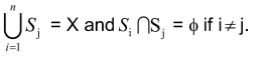
6.Given an arbitrary equivalence relation R in a set X, R divides X into mutually disjoint subsets Si called partitions or subdivisions of X provided:
a.All elements of S, are related to each other for all i.
b.No element of Si is related to any element of St if i≠ j.
c.
The subsets St are called equivalence classes.
7.Union, Intersection and Inverse of Equivalence Relations
a.If R and S are two equivalence relations on a set A, R ∩ S is also an equivalence relation on A.
b.The union of two equivalence relations on a set is not necessarily an equivalence relation on the set.
c.The inverse of an equivalence relation is an equivalence relation.
Top Concepts in Functions
.
.
1.Introduction to functions
A function from a non-empty set A to another non-empty set B is a correspondence or a rule which associates every element of A to a unique element of B written as f : A → B such that f(x) = y for all x ∈ A, y ∈ B.
All functions are relations, but the converse is not true.
2.Domain, Co-domain and Range of a Function
●If f : A → B is a function, then set A is the domain, set B is the co-domain and set {f(x) : x ∈ A) is the range of f.
●The range is a subset of the co-domain.
●A function can also be regarded as a machine which gives a unique output in set B corresponding to each input from set A.
●If A and B are two sets having m and n elements, respectively, then the total number of functions from A to B is nm.
3.Real Function
●A function f : A → B is called a real-valued function if B is a subset of R.
●If A and B both are subsets of R, then ‘f’ is called a real function.
●While describing real functions using mathematical formula, x (the input) is the independent variable and y (the output) is the dependent variable.
●The graph of a real function ‘f’ consists of points whose co-ordinates (x, y) satisfy y = f(x), for all x ∈ Domain(f).
4.Vertical line test
A curve in a plane represents the graph of a real function if and only if no vertical line intersects it more than once.
5.One–one Function
●A function f : A → B is one-to-one if for all x, y ∈ A, f(x) = f(y) ⇒ x = y or x ≠ y ⇒ f(x) ≠ f(y).
●A one-one function is known as an injection or injective function. Otherwise, f is called many-one.
6.Onto Function
●A function f : A → B is an onto function, if for each b ∈ B, there is at least one a ∈ A such that f(a) = b, i.e., if every element in B is the image of some element in A, then f is an onto or surjective function.
●For an onto function, range = co-domain.
●A function which is both one-one and onto is called a bijective function or a bijection.
●A one-one function defined from a finite set to itself is always onto, but if the set is infinite, then it is not the case.
7.Let A and B be two finite sets and f : A → B be a function.
●If f is an injection, then n (A) ≤ n (B) .
●If f is a surjection, then n(A) ≥ n(B).
●If f is a bijection, then n(A) = n(B) .
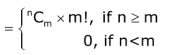
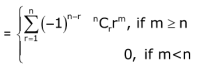
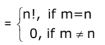
8.If A and B are two non-empty finite sets containing m and n elements, respectively, then Number of functions from A to B = nm.
●Number of one-one function from A to B
●Number of onto functions from A to B
●Number of one-one and onto functions from A to B
9.If a function f : A → B is not an onto function, then f : A → f(A) is always an onto function.
10.Composition of Functions
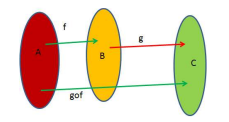
Let f : A → B and g : B → C be two functions. The composition of f and g, denoted by g o f, is defined as the function g o f: A → C and is given by g o f(x): A → C defined by g o f(x) = g(f(x)) ∀x∈ A.
●Composition of f and g is written as g o f and not f o g.
●g o f is defined if the range of f domain of g, and f o g is defined if the range of gdomain of f.
●Composition of functions is not commutative in general i.e., f o g(x) ≠ g o f(x).
●Composition is associative i.e., if f : X → Y, g : Y → Z and h : Z → S are functions, then h o (g o f) = (h o g) o f.
●The composition of two bijections is a bijection.
11.Inverse of a Function
●Let f : A → B is a bijection, then g : B → A is inverse of f if f(x) = y ⟺ g(y) = x OR g o f = lA and f o g = lB
●If g o f = lA and f is an injection, then g is a surjection.
●If f o g’ lB and f is a surjection, then g is an injection.
12. Let f : A → B and g: B → C be two functions. Then
●g o f: A → C is onto ⇒ g: B → C is onto.
●g o f: A → C is one-one ⇒ f:A → B is one-one.
●g o f: A → C is onto and g: B → C is one-one ⇒ f:A → B is onto.
●g o f: A → C is one-one and f:A → B is onto⇒ g: B → C is one-one.
13. Invertible Function
●A function f : X → Y is defined to be invertible if there exists a function g : Y → X such that gof – lx and fog = Iy.
●The function g is called the inverse of f and is denoted by f-1. If f is invertible, then f must be one-one and onto, and conversely, if f is one-one and onto, then f must be invertible.
●If f : A → B and g : B → C are one-one and onto, then g o f : A → C is also one-one and onto. But if g o f is one-one, then only f is one-one and g may or may not be one-one. If g o f is onto, then g is onto and f may or may not be onto.
●Let f : X → Y and g : Y → Z be two invertible functions. Then g o f is also invertible with (g o f)-1 = f-1 o g-1.
●If f: R → R is invertible, f(x) = y, then f-1 (y) = x and (f-1)-1 is the function f itself.
Binary Operations
.
1.A binary operation * on a set A is a function from A × A to A.
2.If * is a binary operation on a set S, then S is closed with respect to *.
3.Binary operations on R
●Addition, subtraction and multiplication are binary operations on R, which is the set of real numbers.
●Division is not binary on R; however, division is a binary operation on R – {0} which is the set of non-zero real numbers.
4.Laws of Binary Operations
●A binary operation * on the set X is called commutative, if a * b = b * a, for every a, b ∈ X.
●A binary operation * on the set X is called associative, if a (b*c) = (a*b)*c, for every a, b, c ∈ X.
●An element e ∈ A is called an identity of A with respect to * if for each a ∈ A, a * e = a = e * a.
●The identity element of (A, *) if it exists, is unique.
5.Existence of Inverse
Given a binary operation * from A × A → A with the identity element e in A, an element a e A is said to be invertible with respect to the operation *, if there exists an element b in A such that a * b = e = b * a and b is called the inverse of a and is denoted by a-1.
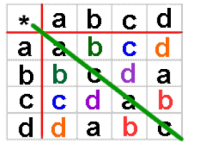
6.If the operation table is symmetric about the diagonal line, then the operation is commutative.
The operation * is commutative.
7.Binary Operation on Natural Numbers
Addition ’+’ and multiplication ‘-‘ on N, the set of natural numbers, are binary operations. However, subtraction ‘—’ and division are not, because (4, 5) = 4 – 5 = -1 ∈ N and 4/5 = .8 ∈ N.
8.Number of Binary Operations
●Let S be a finite set consisting of n elements. Then S x S has n2 elements.
●The total number of functions from a finite set A to a finite set B is [n(B)]n(A). Therefore, total number of binary operations on S is nn2.
●The total number of commutative binary operations on a set consisting of n elements is n n(n−1)2...
Important Questions
Multiple Choice questions-
1.Let R be the relation in the set (1, 2, 3, 4}, given by:
(a) R is reflexive and symmetric but not transitive
(b) R is reflexive and transitive but not symmetric
(c) R is symmetric and transitive but not reflexive
(d) R is an equivalence relation.
2. Let R be the relation in the set N given by: R = {(a, b): a = b – 2, b > 6}. Then:
(a) (2, 4) ∈ R
(b) (3, 8) ∈ R
(c) (6, 8) ∈ R
(d) (8, 7) ∈ R.
3. Let A = {1, 2, 3}. Then number of relations containing {1, 2} and {1, 3}, which are reflexive and symmetric but not transitive is:
(a) 1
(b) 2
(c) 3
(d) 4.
4. Let A = (1, 2, 3). Then the number of equivalence relations containing (1, 2) is
(a) 1
(b) 2
(c) 3
(d) 4.
5. Let f: R → R be defined as f(x) = x4. Then
(a) f is one-one onto
(b) f is many-one onto
(c) f is one-one but not onto
(d) f is neither one-one nor onto.
6. Let f: R → R be defined as f(x) = 3x. Then
(a) f is one-one onto
(b) f is many-one onto
(c) f is one-one but not onto
(d) f is neither one-one nor onto.
7. If f: R → R be given by f(x) = (3 – x³)1/3, then fof (x) is
(a) x1/3
(b) x³
(c) x
(d) 3 – x³.
8. Let f: R – {- 43..} → R be a function defined as: f(x) = 4x3x+4.., x ≠ – 43... The inverse of f is map g: Range f → R -{– 43..} given by
(a) g(y) = 3y3−4y..
(b) g(y) = 4y4−3y..
(c) g(y) = 4y3−4y..
(d) g(y) = 3y4−3y..
9. Let R be a relation on the set N of natural numbers defined by nRm if n divides m. Then R is
(a) Reflexive and symmetric
(b) Transitive and symmetric
(c) Equivalence
(d) Reflexive, transitive but not symmetric.
10. Set A has 3 elements, and the set B has 4 elements. Then the number of injective mappings that can be defined from A to B is:
(a) 144
(b) 12
(c) 24
(d) 64
Very Short Questions:
1.If R = {(x, y) : x + 2y = 8} is a relation in N, write the range of R.
2.Show that a one-one function:
f {1, 2, 3} → {1, 2, 3} must be onto. (N.C.E.R.T.)
3.What is the range of the function f(x) = |x−1|x−1.. ? (C.B.S.E. 2010)
4.Show that the function f : N → N given by f(x) = 2x is one-one but not onto. (N.C.E.R.T.)
5.If f : R → R is defined by f(x) = 3x + 2 find f(f(x)). C.B.S.E. 2011 (F))
6.If f(x) = xx−1.., x ≠1 then find fof. (N.C.E.R.T)
7.If f: R → R is defined by f(x) = (3 – x3)1/3, find fof (x)
8.Are f and q both necessarily onto, if gof is onto? (N.C.E.R.T.)
Short Questions:
1.Let A be the set of all students of a Boys’ school. Show that the relation R in A given by:
R = {(a, b): a is sister of b} is an empty relation and the relation R’ given by :
R’ = {(a, b) : the difference between heights of a and b is less than 3 metres} is an universal relation. (N.C.E.R.T.)
2.Let f : X → Y be a function. Define a relation R in X given by :
R = {(a,b):f(a) = f(b)}.
Examine, if R is an equivalence relation. (N.C.E.R.T.)
3.Let R be the relation in the set Z of integers given by:
R = {(a, b): 2 divides a – b}.
Show that the relation R is transitive. Write the equivalence class [0]. (C.B.S.E. Sample Paper 2019-20)
4.Show that the function:
f : N → N
given by f(1) = f(2) = 1 and f(x) = x -1, for every x > 2 is onto but not one-one. (N.C.E.R.T.)
5.Find gof and fog, if:
f : R → R and g : R → R are given by f (x) = cos x and g (x) = 3x2. Show that gof ≠ fog. (N. C.E.R. T.)
6.If f(x) = 4x+36x−4.., x ≠ 23.. find fof(x)
7.Let A = N x N be the set of ail ordered pairs of natural numbers and R be the relation on the set A defined by (a, b) R (c, d) iff ad = bc. Show that R is an equivalence relation.
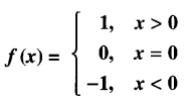
8.Let f: R → R be the Signum function defined as:
and g : R → R be the Greatest Integer Function given by g (x) = [x], where [x] is greatest integer less than or equal to x. Then does fog and gof coincide in (0,1]?
Long Questions:
1.Show that the relation R on R defined as R = {(a, b):a ≤ b}, is reflexive and transitive but not symmetric.
2.Prove that function f : N → N, defined by f(x) = x2 + x + 1 is one-one but not onto. Find inverse of f : N → S, where S is range of f.
3.Let A = (x ∈Z : 0 ≤ x ≤ 12}.
Show that R = {(a, b) : a, b ∈ A; |a – b| is divisible by 4} is an equivalence relation. Find the set of all elements related to 1. Also write the equivalence class [2]. (C.B.S.E 2018)
4.Prove that the function f: [0, ∞) → R given by f(x) = 9x2 + 6x – 5 is not invertible. Modify the co-domain of the function f to make it invertible, and hence find f-1. (C.B.S.E. Sample Paper 2018-19
Assertion and Reason Questions-
1. Two statements are given-one labelled Assertion (A) and the other labelled Reason (R). Select the correct answer to these questions from the codes(a), (b), (c) and (d) as given below.
a)Both A and R are true and R is the correct explanation of A.
b)Both A and R are true but R is not the correct explanation of A.
c)A is true but R is false.
d)A is false and R is also false.
Assertion(A): Let L be the set of all lines in a plane and R be the relation in L defined as R = {(L1, L2): L1 is perpendicular to L2}.R is not equivalence realtion.
Reason (R): R is symmetric but neither reflexive nor transitive
2. Two statements are given-one labelled Assertion (A) and the other labelled Reason (R). Select the correct answer to these questions from the codes(a), (b), (c) and (d) as given below.
a)Both A and R are true and R is the correct explanation of A.
b)Both A and R are true but R is not the correct explanation of A.
c)A is true but R is false.
d)A is false and R is also false.
Assertion (A): = {(T1, T2): T1 is congruent to T2}. Then R is an equivalence relation.
Reason(R): Any relation R is an equivalence relation, if it is reflexive, symmetric and transitive.


 and the ‘range of
  Co-domain is either set B or any of its superset or subset containing range of R.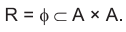
 domain of g, and f o g is defined if the range of g
 domain of f.